

Over the past year, AI Search has triggered a wave of new tactics, new acronyms, and a lot of confusion.
People started talking about AEO, GEO, AI hacks, llms.txt files, content chunking, and publishing thousands of long-tail pages just to gain visibility in AI-generated results. The assumption was simple: if search is changing, then traditional SEO must be losing value.
But Google’s latest guidance points in a different direction.
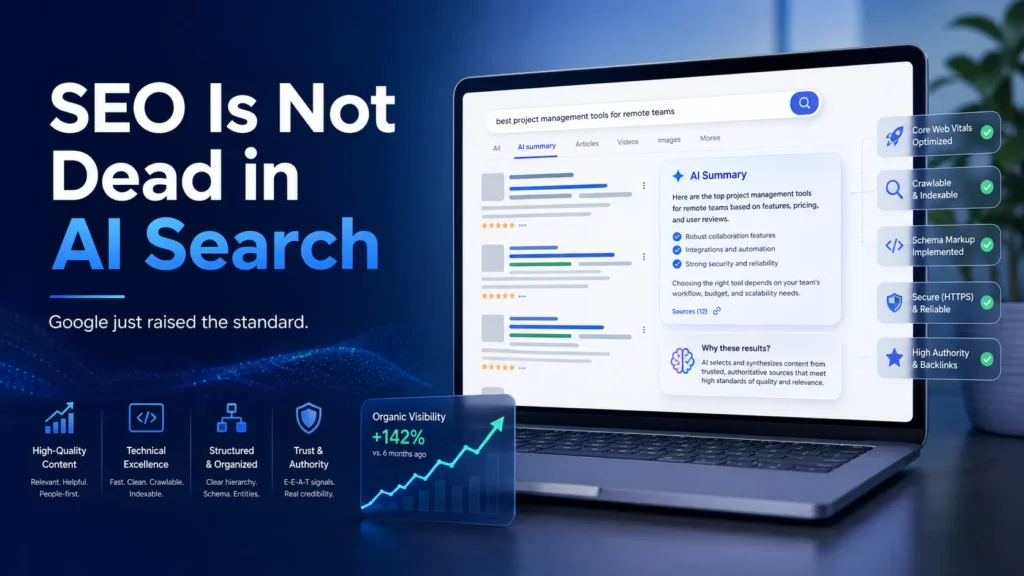
SEO is not dead. If anything, AI Search is making good SEO even more important.
AI Search is not a shortcut game
As AI Overviews and AI Mode continue to expand, many site owners are looking for quick ways to stay visible. Some are trying to reverse-engineer formatting tricks. Others are treating AI Search like a completely separate channel with a brand-new rulebook.
That is the wrong mindset.
Google’s message is much simpler: if you want visibility in AI-powered search, focus on creating better content, improving your website, and building stronger trust signals. In other words, focus on better SEO, not shortcuts.
What Google is really saying
Some of the clearest takeaways from Google’s guidance include:
- Helpful, experience-based content matters more than ever.
- AI-generated content is acceptable, but low-value mass content is not.
- Google understands meaning and intent, not just exact-match keywords.
- You do not need llms.txt or special AI-only files.
- “Chunking” content specifically for AI is unnecessary.
- Technical SEO still matters.
- Strong brands, real expertise, and authentic mentions are becoming more important.
None of this suggests SEO is disappearing. It suggests that weak SEO is becoming easier to ignore.
The rise of non-commodity content
One of the most important ideas in this shift is the value of non-commodity content.
Commodity content is generic content. It is the kind of article almost anyone can publish with minimal effort. It often repeats the same advice, follows the same structure, and adds little original value.
Non-commodity content is different. It comes from real work, firsthand experience, and useful insights that are harder to copy.
For example:
“7 Roof Maintenance Tips Every Homeowner Should Know”
versus
“What We Learned After Repairing 200 Roof Leaks During Storm Season”
Both topics are about roofing. But they do not carry the same weight.
The first is broad and generic. The second signals real-world experience, specificity, and credibility. It feels more useful because it is based on actual work, not recycled advice.
That is where search is heading. Content with firsthand knowledge and original insight has a stronger chance of standing out.
AI content is not the problem
There is still a lot of confusion around AI-generated content.
Google is not saying AI is automatically bad. AI can support outlining, drafting, ideation, summarizing, and editing. The real question is whether the final content is useful.
If AI is used to mass-produce shallow pages with little value, that content is unlikely to perform well in the long run. But if AI helps improve workflow while the content still reflects expertise, accuracy, and originality, then it is simply a tool.
The standard is not whether AI was used. The standard is whether the content genuinely helps people.
Technical SEO still matters
Some people assume AI Search makes technical SEO less relevant. That is not true.
Technical SEO still helps search engines crawl, understand, and surface your content. A site with poor structure, weak internal linking, rendering issues, slow performance, or indexing problems can still struggle, even if the content is strong.
The fundamentals still matter:
- Clean site architecture
- Strong internal linking
- Crawlability and indexability
- Fast, stable performance
- Structured data where appropriate
- Clear page hierarchy
There is also no strong evidence that websites need special AI-specific files or unusual formatting tricks to be included in AI Search. In most cases, the smarter approach is still the simplest one: make your content accessible, organized, and genuinely useful.
Trust and brand matter more
Another key takeaway is the growing importance of trust, authority, and brand strength.
As search systems improve, they are also getting better at identifying credible sources. That includes websites with real expertise, consistent publishing, authentic mentions, and stronger brand signals.
This does not only benefit large companies. Smaller websites can compete too, especially if they publish original content, demonstrate subject knowledge, and build credibility over time.
For SEO professionals, this means visibility is no longer just about keyword placement. It is also about reputation, trust, and the ability to create content people actually rely on.
The future of SEO in AI Search
In my view, AI Search is not replacing SEO. It is raising the standard.
The websites most likely to win are the ones that combine:
- Real expertise
- Helpful content
- Strong technical SEO
- Trust and authority
- Original insights
Search is changing, and AI is changing how people discover information. But the core principle remains the same.
Create content that genuinely helps people.
That has always been good SEO. Now it matters even more.