

Local SEO · Bridge Page Strategy · Semantic SEO · Advanced Schema · Case study Steeline
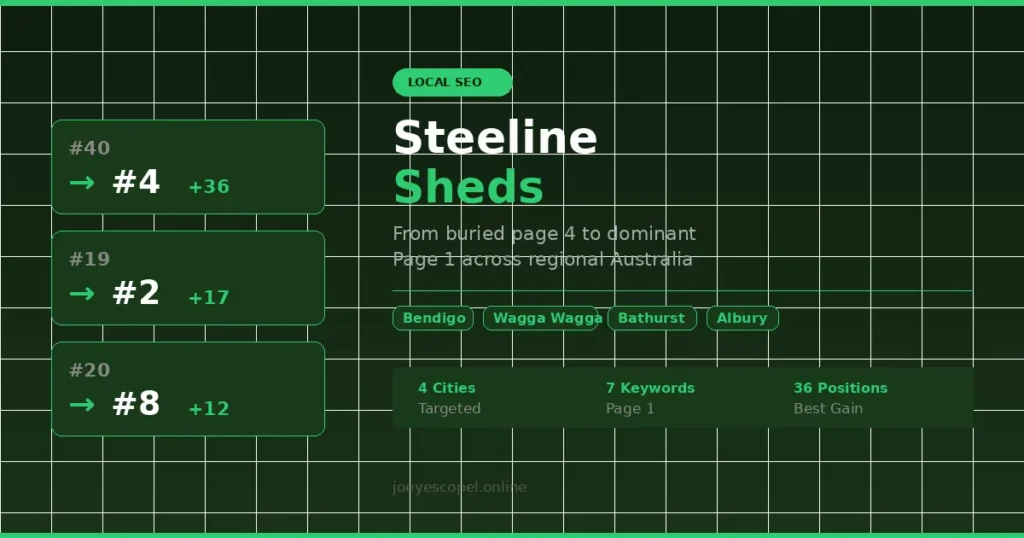
Table of Contents
Overview
Steeline is one of Australia’s largest steel building manufacturers, operating as a franchise network with location-specific pages across regional markets. The campaign targeted five key locations:
- Albury, NSW
- Bathurst, NSW
- Bendigo, VIC
- Shepparton, VIC
- Wagga Wagga, NSW
The goal was to rank high-intent commercial and transactional shed keywords in each of these markets — moving from page 2–4 positions into dominant page 1 and top 3 results.
The Core Challenge — Franchise Page Limitations
This is where the campaign required genuine creative problem-solving. Steeline’s location pages are franchise-controlled, meaning:
- Each location page had a fixed template — just a header and a small block of basic information
- There was no ability to edit or expand the on-page content directly
- Standard on-page SEO optimisation was essentially off the table
- Competing pages from other shed brands had full editorial control of their content
Most SEO Specialist would stop here and declare the campaign too limited to execute properly. The franchise template constraint is a genuine wall that blocks the most common local SEO tactics.
We had to think completely outside the box. The solution wasn’t to fight the franchise template — it was to build around it.
The Strategy — Bridge Page Architecture
The core insight was that Steeline operates two separate but connected web properties:
- steeline.com.au — the main national brand site (franchise location pages live here)
- steelinesheds.com.au — a dedicated shed-focused subdomain/site with full editorial control
This created an opportunity to build a Bridge Page Strategy — using the shed-specific site as the SEO workhorse that feeds authority and relevance back to the main brand, while capturing ranking power across all target locations and query types.
How the Bridge Page Strategy Works
- Identify the franchise page limitations on steeline.com.au — accept that direct on-page optimisation is not possible for location pages
- Build fully optimised location and category pages on steelinesheds.com.au with complete editorial control
- Optimise all available real estate on the constrained franchise pages — every heading, meta tag, alt text, anchor text, and any editable field
- Create a deliberate interlinking architecture: steelinesheds.com.au → steeline.com.au, passing topical authority and ranking signals across the two properties
- Target all three product verticals on the bridge pages: sheds, roofing, and fencing — capturing the full commercial intent keyword set across each location
Available Optimisation Space Used
Even within the franchise template constraints, every available element was fully utilised:
- Page title and meta description — fully optimised for location + commercial intent
- H1 and any available heading tags — structured around primary keyword targets
- Image alt text — geo-targeted and product-specific
- Internal anchor text — carefully chosen to pass topical signals
- Any editable copy blocks — treated as premium SEO real estate
- URL slug structure — aligned with target keyword hierarchy
Semantic SEO & Entity Optimisation
Beyond the bridge page architecture, the content itself was built using advanced semantic SEO principles to ensure both search engines and AI language models could correctly understand, classify, and surface the pages.
Content Structure for LLM & Search Engine Parsing
Modern search increasingly relies on large language models to interpret content. The content was structured specifically to make parsing easy and unambiguous:
- Bullet points and numbered lists used throughout — structured formats that LLMs parse and extract from more reliably than dense prose
- Short, declarative sentences preferred — reduces ambiguity in entity extraction
- Explicit product-location associations stated clearly — e.g. ‘Steeline Bendigo supplies sheds, garages, and garden sheds to the Bendigo, VIC region’
- Topical clusters built around each location — covering sheds, roofing, and fencing as related but distinct verticals
Entity Implementation
Relevant semantic entities were identified and woven throughout the content to build topical authority signals:
- Brand entities — Steeline, steelinesheds.com.au, steeline.com.au connected explicitly
- Product entities — sheds, garden sheds, garages, farm sheds, roofing, fencing
- Location entities — each city with state, postcode, and regional context
- Industry entities — steel buildings, prefabricated structures, franchise network
- Relationship entities — supplier, manufacturer, installer, franchise partner
Advanced Schema Implementation
A multi-layered schema strategy was implemented, going well beyond standard LocalBusiness markup to build a fully interconnected knowledge graph presence.
Schema Types Implemented
- LocalBusiness — for each franchise location with full address, opening hours, geo coordinates, and service area
- Organization — connecting the franchise locations back to the parent Steeline brand entity
- Product — for shed, roofing, and fencing product categories with material and specification data
- BreadcrumbList — structured navigation for search engine crawl and rich result eligibility
- FAQPage — common shed and roofing queries structured for potential rich results
- WebPage + WebSite — with sitelinks search box and canonical signals
Wikipedia & Wikidata Entity Integration
To establish unambiguous entity connections to the broader knowledge graph, schema markup was enriched with explicit references to verified external sources:
- sameAs properties — linking Steeline entities to their corresponding Wikidata QIDs and Wikipedia article URLs where available
- Wikipedia references — used for material entities (steel, corrugated iron, galvanised steel) to establish clear topical associations
- Wikidata IDs — attached to location entities (Bendigo, Wagga Wagga, Bathurst, Albury) providing unambiguous geographic entity resolution
- knowsAbout — declaring the brand’s areas of expertise explicitly in structured data (steel sheds, farm buildings, roofing systems, rural fencing)
- Knowledge Graph IDs — where available, Google Knowledge Graph IDs were referenced via sameAs to reinforce entity disambiguation
- mentions — schema mentions properties used to explicitly associate product entities with location entities within each page’s structured data
Cross-Site Schema Interconnection
The schema implementation was designed to work across both domains — not just within individual pages:
- steelinesheds.com.au Organisation schema linked to steeline.com.au as the parent brand via parentOrganization
- Location pages on each domain cross-referenced each other via sameAs and url properties
- Product schema on the shed site referenced the main brand’s offers and service locations
- This created a coherent, interconnected entity graph visible to Googlebot across both web properties
Why this matters: When Google’s knowledge graph can clearly resolve who Steeline is, what they sell, where they operate, and how steelinesheds.com.au relates to steeline.com.au — it becomes much easier to rank confidently for commercial queries in each target location.
Campaign Results
📍 Bendigo — Biggest Turnaround
| Keyword | Before | After |
| bendigo sheds for sale | #40 | #4 (+36) |
| bendigo shed | #20 | #8 (+12) |
| bendigo shed companies | #14 | #5 (+9) |
| bendigo shed builders | #12 | #5 (+7) |
| bendigo sheds and garages | — | #4 |
| bendigo garden sheds | — | #3 |
📍 Wagga Wagga — Strongest Single Jump
| Keyword | Before | After |
| wagga shed | #19 | #2 (+17) |
| wagga shed builders | #13 | #11 (+2) |
| garden sheds wagga | — | #3 |
| sheds for sale wagga | — | #4 |
📍 Bathurst — Three #1 Rankings
| Keyword | Final Rank |
| shed bathurst | #1 🏆 |
| bathurst shed builders | #1 🏆 |
| garden sheds bathurst | #1 🏆 |
| bathurst shed companies | #2 |
📍 Albury — Top 3 Across Every Term
| Keyword | Final Rank |
| albury shed | #1 🏆 |
| albury sheds for sale | #1 🏆 |
| albury shed suppliers | #1 🏆 |
| albury shed company | #2 |
| albury shed builders | #3 |
Bottom Line
This wasn’t a standard local SEO campaign. The franchise constraint forced a more sophisticated solution — and that solution produced results that a conventional approach never would have. The bridge page strategy, combined with semantic entity optimisation and a fully interconnected schema graph, gave Steeline a competitive edge that was genuinely difficult for competitors to replicate.
Key campaign metrics:
- 📈 bendigo sheds for sale: #40 → #4 (+36 positions)
- 📈 wagga shed: #19 → #2 (+17 positions)
- 📈 bendigo shed: #20 → #8 (+12 positions)
- 📈 bendigo shed companies: #14 → #5 (+9 positions)
- 📈 bendigo shed builders: #12 → #5 (+7 positions)
- 🏆 Bathurst — #1 for 3 separate commercial keywords
- 🏆 Albury — #1 for 3 separate commercial keywords
Industry: Home Improvement / Steel Manufacturing · Market: Regional Australia · Focus: Bridge Page Strategy, Franchise SEO, Semantic SEO, Advanced Schema
[ BUTTON BLOCK — CTA ]
Button text: ‘Have a similar constraint? Let’s solve it together’
Button link: → /contact