

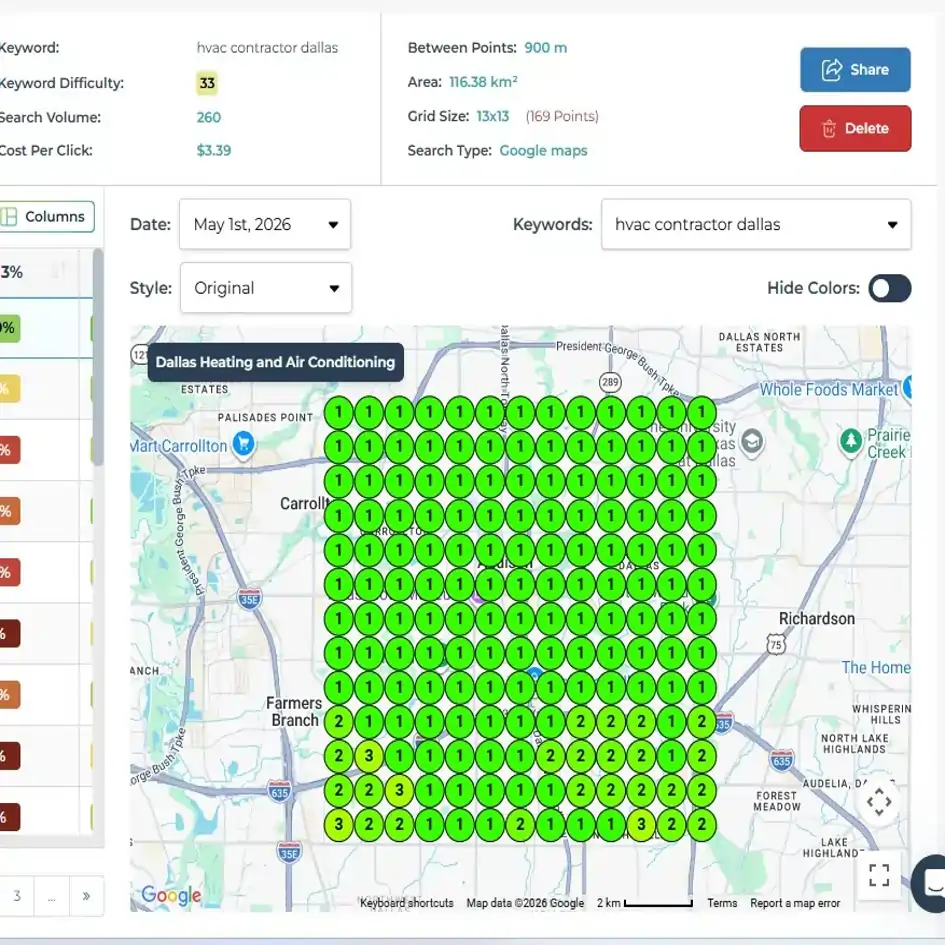
A Dallas-area HVAC company had strong reviews, an active Google Business Profile, and a solid local reputation, but rankings stayed flat for 7 months across its service area.
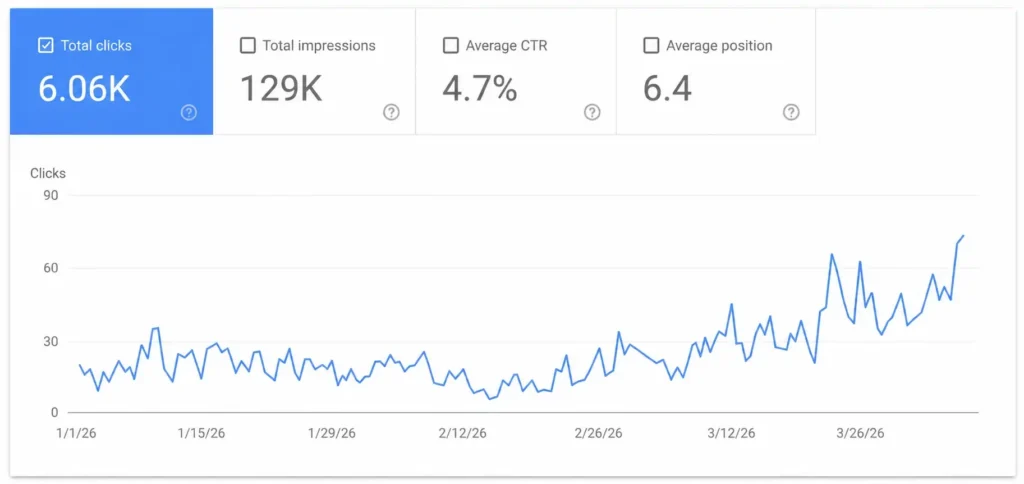
In 90 days, the business moved from position 13 to position 2, increased Map Pack visibility from 18% to 73%, and grew GBP calls from 41 to 168 per month, all without new backlinks or ad spend.
Client background
The company served North Dallas suburbs and already had many of the local SEO signals most agencies focus on first.
It had 156 Google reviews, a 4.8-star rating, a clean GBP, and regular weekly posting, yet it remained stuck at position 13 in key local searches.
Challenge
At first glance, the problem looked like competitor strength.
But the business was not losing because of weak reviews, poor citations, or an inactive profile; the real issue was that the website gave Google no clear topical identity to trust and rank.
The site tried to cover HVAC, plumbing, and general home services under one brand message.
That diluted relevance and made it harder for Google to understand what the business should be known for in the local market.
Strategy
The entire strategy centered on one goal: make the business easier for Google to understand.
Instead of chasing more links or more reviews, the work focused on entity clarity, topical structure, internal support content, and stronger on-page alignment.
The positioning was narrowed to one Central Entity: residential AC repair contractor serving North Dallas suburbs.
From there, every major page, content cluster, internal link, and schema signal was rebuilt to reinforce that one identity.
Implementation
1. Central entity focus
The first move was reducing topical confusion.
Plumbing pages were moved off the site, general home services framing was removed, and the brand was repositioned around residential AC repair in North Dallas suburbs.
2. Core and outer topical map
Next, the site architecture was split into two content layers.
Core pages targeted direct commercial intent, such as AC repair and emergency AC service in specific cities, while Outer pages supported those assets with broader educational topics tied to local pain points and seasonal demand.
Examples of Core pages included:
- AC repair in Plano
- Emergency AC in Frisco
- Refrigerant leak service in Richardson
- Condenser replacement in McKinney
- AC tune-up in Carrollton
Examples of Outer pages included:
- How Texas summer humidity affects AC load
- Condensate drain issues in older Garland homes
- Why attic insulation changes AC costs in Frisco
- Short cycling during Plano summers
- Seasonal refrigerant leak warning signs
Each Outer page linked back to a relevant Core page, giving the site both conversion-focused content and trust-building topical depth.
3. EAV page rewrites
The Core service pages were then rewritten using Entity-Attribute-Value logic.
Generic marketing copy was replaced with factual statements about service timelines, licensing, pricing ranges, equipment brands, and response windows so the pages communicated clearer signals.
In total, 47 sentences across 9 service pages were rewritten in this format.
That made the content more specific, more extractable, and more useful to both search engines and users.
4. sameAs schema and entity validation
The LocalBusiness schema was expanded with 8 verified sameAs references.
These included the Google Business Profile, Facebook, Yelp, BBB, Houzz, ACCA directory listing, Texas TACLA license record, and LinkedIn company page.
That helped consolidate off-site references into a more consistent entity signal.
Within 21 days, the brand entity began appearing in Search Console as a recognized term.
5. Micro-context in supplementary content
Supplementary elements like sidebars, FAQs, footers, and related content blocks were also rewritten to improve contextual coverage.
Instead of leaving those sections generic, they were seeded with lexical contrasts and related service angles, such as pairing emergency repair pages with scheduled tune-up references or repair pages with pricing and maintenance topics.
6. Homepage quality nodes
The homepage was updated to link directly to deeper educational content rather than only listing services.
This strengthened crawl paths and pushed high-quality Outer content closer to the top of the site architecture.
7. Signal alignment
For each Core page, the URL, title tag, and H1 were aligned around the same entity, service intent, and geography.
That reduced ambiguity and gave Google one consistent interpretation of each page’s purpose.
8. Grid-based local rank tracking
Progress was measured using a 121-point Local Falcon grid rather than relying on one average ranking position.
The tracking covered Plano, Frisco, Richardson, Garland, Irving, McKinney, Carrollton, and Allen, making it possible to see where visibility was strong and where expansion opportunities remained.
Results
After 90 days, the business moved from position 13 to position 2.
Map Pack visibility improved from 18% to 73%, and GBP calls increased from 41 in December to 168 in March.
Just as important, those gains happened without new backlinks, without ad spend, and without any change to the business’s address, review count, or underlying brand reputation.
The performance lift came from making the entity and website structure clearer, not from adding more noise.
Business impact
Using the company’s reported ticket range of $385 to $2,200, even a modest close rate created significant revenue upside from organic visibility alone.
At 168 monthly calls and a 30% close rate, the business could generate more than 50 jobs per month, and at a $900 average ticket, that equates to roughly $45,000 in monthly revenue from organic search.
This campaign did not win because of a shortcut. It won because the website finally gave Google a clear, consistent understanding of what the business was, where it operated, and which services it should rank for. Once the entity became legible, rankings followed.